You wake up, open your sleep app, and the first thing you see is a score. It tells you last night was a 68.
What are you supposed to do with that? Is 68 good? Is it lower than yesterday's 74 because you slept less, went to bed later, or tossed and turned more?
A sleep app should help you sleep better, not make you feel like you're being tested every night. So instead of handing you a score to worry about, Sleepwave measures what sleep experts agree on most: how long you sleep. That gives you a sleep goal to aim for.
What's a sleep score?
Sleep scores are everywhere. A number out of 100 is easy to read and feels familiar, like a grade on a test.
But there's no scientific standard for what a sleep score measures.¹ Each tracker builds its own score from a different mix of inputs, such as how long you slept, how often you woke up, how much time you spent in each sleep stage, and sometimes your heart rate.
Sleepwave founder Jules Goldberg says, "I'm obsessed with measuring things accurately. So when it comes to measuring breathing, sleep or snoring, I really want to get it as accurate as possible. When measuring sleep, I just don't think you can measure sleep quality and put it into a single number. There are too many variables at play."
A single score can also hide the thing you most need to know: what to do differently tonight.
Can a sleep score make you worry more?
Doctors are seeing signs of an unhealthy fixation on sleep data in their patients.¹ Sleep researchers have a name for it: orthosomnia. The term was introduced in 2017 to describe patients whose efforts to perfect their sleep-tracker data ended up making their sleep problems worse.²
What a tracker tells you can even change how you feel the next day. In a 2018 University of Oxford study, 63 people with insomnia received fake feedback from a sleep-tracking watch. About half were told they'd slept well, and the rest were told they'd slept badly. By the evening, those told they'd slept badly rated themselves as less alert and more tired, even though the feedback had nothing to do with their real sleep.³
How much sleep do adults really need?
In 2015, the American Academy of Sleep Medicine (AASM) and the Sleep Research Society (SRS) brought together a panel of 15 experts, who reviewed more than 5,000 scientific articles on sleep duration and health. Their conclusion: adults aged 18 to 60 should sleep 7 or more hours a night on a regular basis to promote optimal health.⁴
Regularly sleeping less than 7 hours is associated with weight gain and obesity, diabetes, high blood pressure, heart disease and stroke, depression, impaired immune function, more errors, a greater risk of accidents and an increased risk of death.⁴
The panel also noted that sleep needs vary from person to person, influenced by genetic, behavioral, medical and environmental factors.⁴
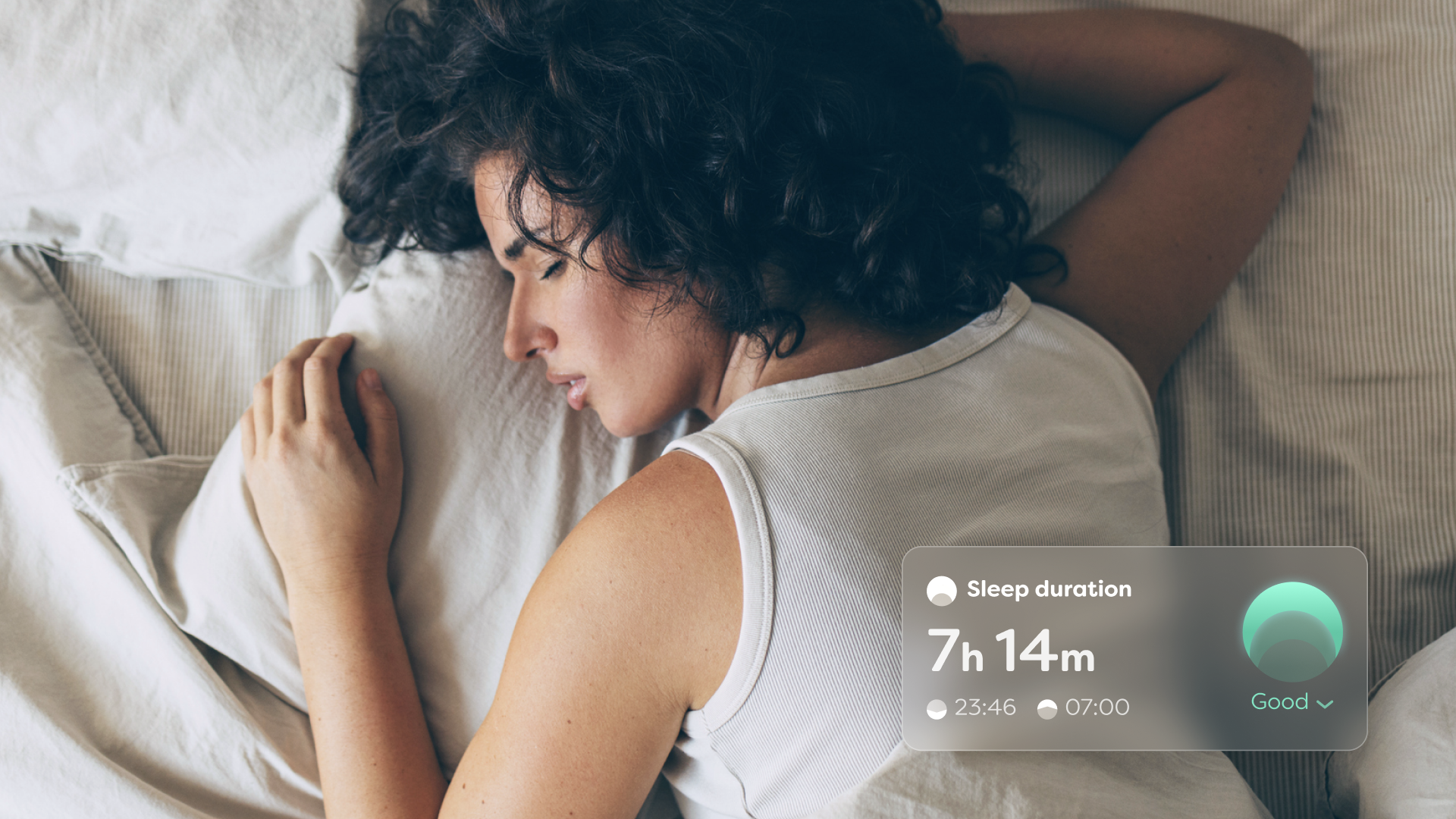
Why a sleep goal works better than a score
1. Sleep quality can't be reduced to a single number
Healthy sleep has several parts: enough sleep, good quality, the right timing, a regular routine, and no sleep disorders.⁴ A score squeezes all of them into one number, often using a formula you can't see.
2. Sleep duration is clear and measurable
Instead of guessing at quality, we start with something you can see and track night after night: how long you slept. It's also the part of sleep with the clearest expert guidance.
3. 7 or more hours is a simple, science-backed baseline
The AASM and SRS recommend that adults get at least 7 hours of sleep a night.⁴ That gives you a simple starting point for your goal. You can set it higher if you know you need more.
4. Hitting your goal feels like progress
Reaching your sleep goal is a clear win. Each night you hit it counts, and over a week or a month, those nights become a habit you can be proud of.
5. Less pressure, less worry
A score can feel like a grade you're given every morning, and fixating on sleep data can make some people more anxious.¹ A goal is something you're working toward.
How the sleep goal works in Sleepwave
Sleepwave puts sleep duration front and center, so the first thing you see each morning is how long you actually slept.
- A goal of 7+ hours of actual sleep. Your goal counts the time you're actually asleep, not just the time you spend in bed.
- Sleep tracking from your phone. Sleepwave is designed to measure your real sleep time using just your phone, with no wearable to put on or charge.
- Waking up in the night doesn't reset your progress. Some time awake during the night is normal.⁵ Sleepwave counts your sleep before and after a wake-up as one night, because what matters is getting 7+ hours in total.
- See how long it takes you to fall asleep. A long wind-down can be a sign you were overstimulated before bed, for example by screen time.⁶ That can cut into your total sleep.
- Track your progress over time. The Sleepwave app will soon show how often you hit your goal over weeks and months, with streaks for consecutive nights you reach 7+ hours.
Sleepwave is a wellness app, not a medical device, and it can't diagnose sleep disorders.⁷ If you're worried about your sleep, talk to your doctor.⁴
Will Sleepwave ever have a sleep score?
We're not against sleep scores. When they're built carefully and explained clearly, they can be a helpful way to see a lot of information at once. If we ever introduce one, it will have to be accurate, credible, well developed and backed by research.
For now, we think there's a better approach: breaking sleep down into its separate parts.
"I'd rather track the components as accurately as possible and look at evidence-based thresholds," says Jules, "rather than trying to merge everything into a single number."
In the meantime, we'd rather give you one clear goal than a number we can't fully stand behind.
Key takeaways
- Sleep experts recommend that adults get at least 7 hours of sleep a night, and individual needs vary.
- There's no standardized "sleep score," and fixating on sleep data can make some people more anxious.
- Sleepwave puts your sleep duration front and center and lets you set a goal that works for you.
Frequently asked questions
How many hours of sleep do adults need? The American Academy of Sleep Medicine and the Sleep Research Society recommend that adults aged 18 to 60 sleep at least 7 hours a night on a regular basis.⁴
What is a sleep goal? A sleep goal is the amount of sleep you aim to get each night. In the Sleepwave app, you can set a baseline sleep goal and compare it with your tracked sleep over time.
Are sleep scores accurate? There's no standard definition of a sleep score. Each app combines different measurements in its own way, so scores from different apps can't be compared directly.
Can sleep tracking make your sleep worse? For some people, yes. Researchers use the term "orthosomnia" to describe cases where trying to perfect sleep-tracker data makes sleep problems worse.² Focusing on a simple goal and long-term trends can help.
Can you catch up on sleep on the weekend? Research suggests that sleeping in on the weekend doesn't fully reverse the effects of too little sleep during the week.⁸ ⁹ Getting enough sleep most nights works better.
References
- Nagesh A. Why 'sleepmaxxing' could be making your sleep worse. BBC News. September 3, 2026. https://www.bbc.co.uk/news/articles/c99drr70m2eo
- Baron KG, Abbott S, Jao N, Manalo N, Mullen R. Orthosomnia: are some patients taking the quantified self too far? Journal of Clinical Sleep Medicine. 2017;13(2):351–354. doi:10.5664/jcsm.6472
- Gavriloff D, Sheaves B, Juss A, Espie CA, Miller CB, Kyle SD. Sham sleep feedback delivered via actigraphy biases daytime symptom reports in people with insomnia: implications for insomnia disorder and wearable devices. Journal of Sleep Research. 2018;27(6):e12726. https://onlinelibrary.wiley.com/doi/10.1111/jsr.12726
- Watson NF, Badr MS, Belenky G, et al. Recommended amount of sleep for a healthy adult: a joint consensus statement of the American Academy of Sleep Medicine and Sleep Research Society. Journal of Clinical Sleep Medicine. 2015;11(6):591–592. doi:10.5664/jcsm.4758. https://pmc.ncbi.nlm.nih.gov/articles/PMC4442216/
- Sleep Foundation. Wakefulness after sleep onset (WASO). Updated July 25, 2025. https://www.sleepfoundation.org/sleep-studies/wakefulness-after-sleep-onset
- Chang AM, Aeschbach D, Duffy JF, Czeisler CA. Evening use of light-emitting eReaders negatively affects sleep, circadian timing, and next-morning alertness. Proceedings of the National Academy of Sciences. 2015;112(4):1232–1237. doi:10.1073/pnas.1418490112
- Khosla S, Deak MC, Gault D, et al. Consumer sleep technology: an American Academy of Sleep Medicine position statement. Journal of Clinical Sleep Medicine. 2018;14(5):877–880. doi:10.5664/jcsm.7128
- Depner CM, Melanson EL, Eckel RH, et al. Ad libitum weekend recovery sleep fails to prevent metabolic dysregulation during a repeating pattern of insufficient sleep and weekend recovery sleep. Current Biology. 2019;29(6):957–967. https://www.cell.com/current-biology/fulltext/S0960-9822(19)30098-3
- University of Colorado at Boulder. Does extra sleep on the weekends repay your sleep debt? No, researchers say. ScienceDaily. February 28, 2019. https://www.sciencedaily.com/releases/2019/02/190228113534.htm